
There is a moment in lighting design when light moves beyond its technical function and becomes a true design language. It is no longer just about performance, or simply about enabling vision, but about shaping perception, defining surfaces, and building atmospheres. In other words, it becomes an integral part of the project’s identity.
It is within this delicate balance between function and atmosphere that PUK’s approach takes shape. And it is exactly here that the new 2026 catalogue comes to life.
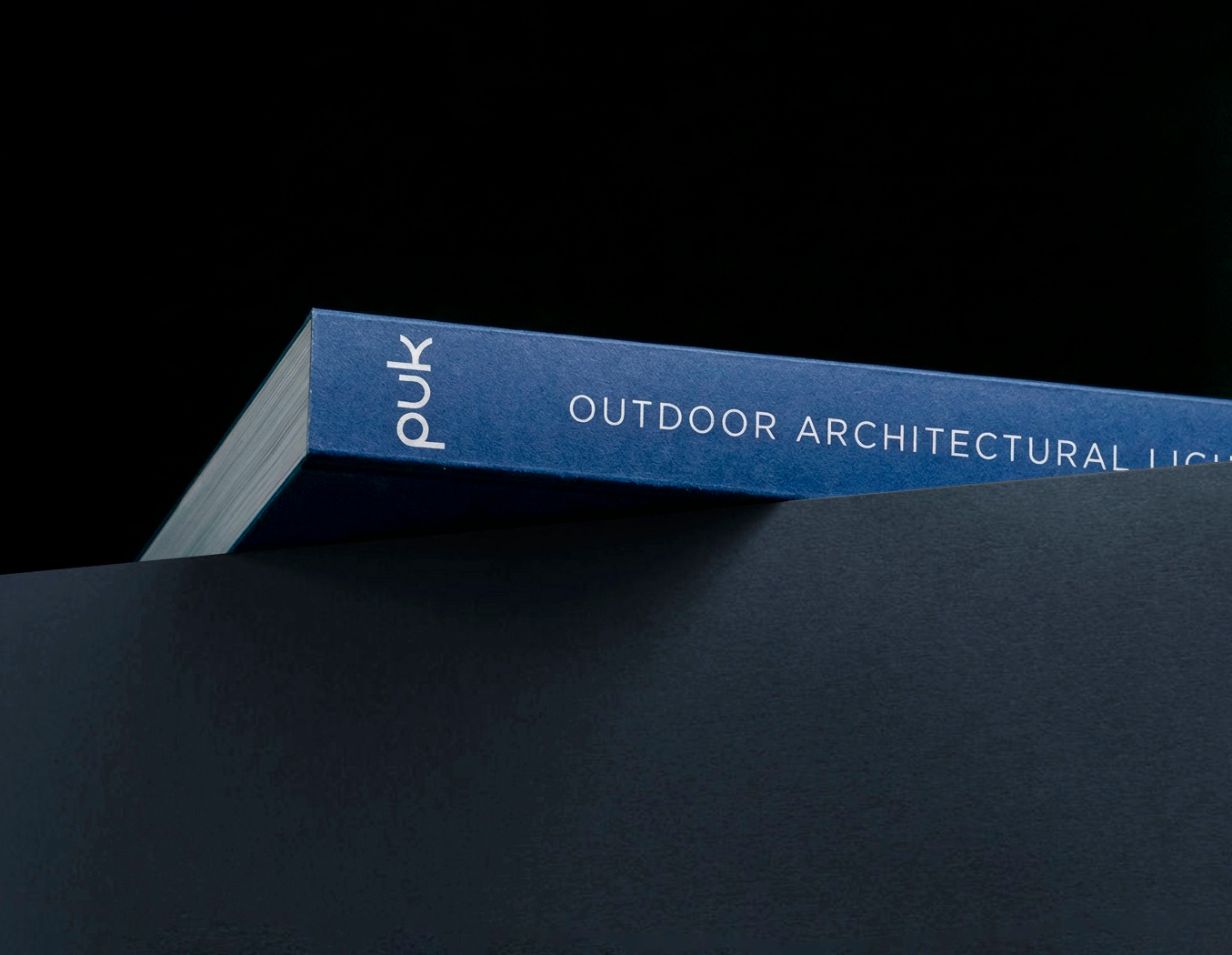
A decisive step forward, marking a significant evolution in how light is specified, configured, and experienced. The 2026 Collection Book is not merely an update of the product range, but a shift in perspective: a more precise yet more flexible design tool, supporting lighting designers, architects, and exterior planners in exploring configurations, optical solutions, and lighting scenarios yet to be defined.
In a context where light is no longer a secondary element, but a key driver in shaping spaces, enhancing architectural features, and generating visual comfort and emotion, we have introduced a new system that redefines how our product portfolio is navigated — bringing the catalogue closer to the real workflow of professionals.
A new language to design light
The key innovation of the 2026 catalogue lies in its new product coding system. Each luminaire is identified through a unique, structured code that enables precise definition of all available variants.
The product code is composed of:
- product code
- light source code
- beam angle code
- finish code
- dimming code
- accessory code
This structured approach unlocks a new level of design freedom in specifying PUK luminaires.
It allows for highly tailored configurations, adapting each product to the specific requirements of the project in terms of photometric performance, optical control and aesthetic integration.
A system that combines accuracy and flexibility. On one hand, it ensures full control over specification; on the other, it enables a virtually limitless range of combinations — within the available configurations. For each product family, all variants are clearly outlined in the catalogue, ensuring immediate readability and streamlined selection of the most suitable solution.
A layout designed for the project
To support this new approach, the catalogue layout has been completely rethought. The 432 pages of the 2026 collection book — intentionally more concise than previous editions — reflect a clear intention: to streamline, clarify and prioritise what truly matters in specification.
Technical tables take centre stage, forming the backbone of the new coding system, and are complemented by high-impact visual content that illustrates potential application contexts.
The introductory section plays a key role in this system: the index and legend are positioned at the beginning of the catalogue to guide users through the structure, ensuring immediate understanding of the new reading and configuration logic.
Technical performance, design control and expressive freedom
The 2026 catalogue is structured into 9 product categories and includes 73 product families.
A comprehensive yet highly organised system designed to meet the complex needs of contemporary lighting design.
Each category addresses a specific application field, each family a targeted solution, and each product a precise tool within a broader design strategy. Within this framework, every luminaire is conceived not only to deliver performance, but also to integrate seamlessly with other solutions, maintaining a continuous balance between photometric efficiency, visual comfort, and architectural integration.
Within this context, one of the most relevant developments of the catalogue takes shape: the new “DECOR” category.
DECOR: when lighting becomes spatial experience
Among the most significant evolutions introduced in the 2026 catalogue, the new DECOR category marks a clear expansion of PUK’s approach — bridging technical lighting and decorative expression.
For the first time, PUK introduces a product range where lighting is not only functional, but also expressive and decorative. Not just illumination, but presence. DECOR luminaires are designed to generate atmosphere and to interact with the environment in a more immediate, perceptual way. They do not simply light a space: they define it, characterise it, and contribute to its visual identity.
This category represents a natural progression of PUK’s design philosophy: a convergence of consolidated lighting expertise and a renewed focus on atmospheric and emotional lighting.
In products such as Vetra Sphera, Vetra Filis, Vetra Dot, Flexa Sphera, Flexa Filis, Flexa Dot, Rondis, and Lucea, PUK’s engineering expertise supports a new design requirement: shaping light as a visual and spatial element.
This is where optics, materials, and design language meet, creating solutions where lighting performance and emotional impact coexist in perfect balance.
Shaping light, sculpting art: a continuous dialogue
The 2026 catalogue continues a narrative that began at Light + Building — a dialogue between light and art, matter and perception, geometry and emotion.
The same sculptural presence that defined the exhibition stand now appears on the catalogue cover, becoming a symbol of this ongoing vision: light not only as a tool to enhance art, but as an artistic medium in its own right.
Within this vision, a new approach to lighting design emerges: more informed, more precise, yet more open to interpretation. A system where each selection becomes a configuration, each configuration becomes a design statement, and each project evolves into a unique lighting narrative — adaptive, scalable, and fully integrated into the architectural context.
In a single platform, PUK brings together expertise, solutions, and design flexibility, offering a new way of approaching lighting specification.
